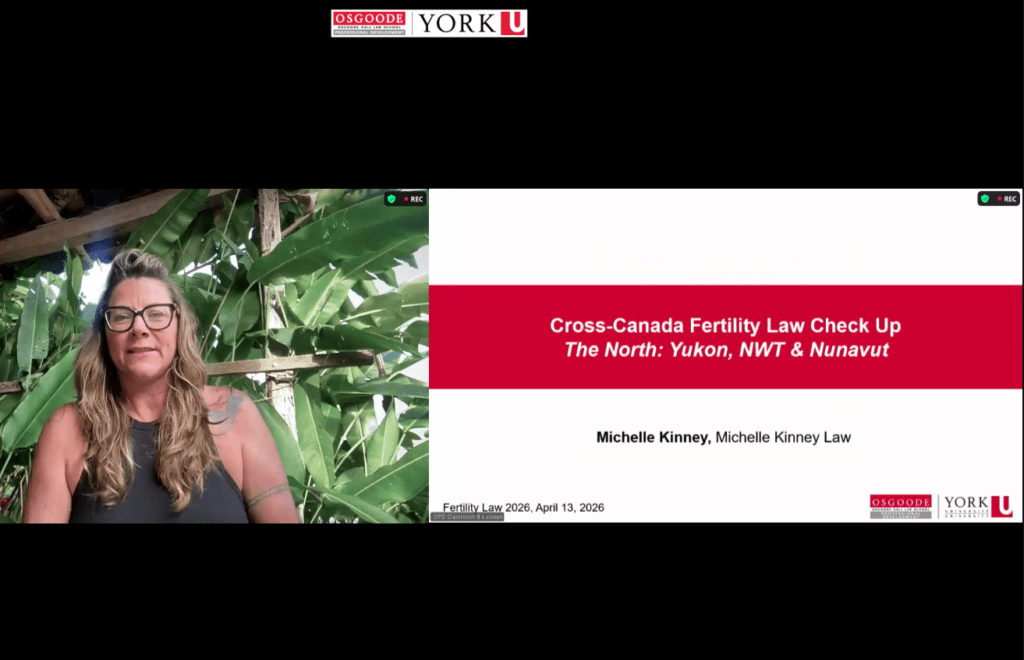
I was honoured to be a presenter at the Osgoode 2026 Fertility Law Program and to have had the opportunity to participate in the Cross-Country Fertility Law Check-Up. I provided an overview of developments across British Columbia and the North, including Yukon, the Northwest Territories, and Nunavut, and highlighted emerging legal trends and issues in those jurisdictions.
I also had to start with a quick apology for my attire and surroundings that day. I joined remotely from Guatemala and was presenting from outside my hotel. I’ve intentionally structured my law practice in a way that allows me to work remotely and continue travelling, and this was one of those examples — presenting at a Canadian legal conference while sitting in Guatemala. It’s one of the things I enjoy most about building a practice that provides flexibility and allows me to work from wherever I happen to be.
That said, it was exceptionally hot and, despite my best intentions, the climate won– hence I am not wearing a jacket and look less professional than I would have preferred 🙂 . Thankfully, the fertility law content ended up being far more organized than my tropical work setup.
Below is an update of the topics covered in my presentation.
Public Funding for IVF in Canada – Snapshot
Canada has no national IVF program. Coverage is decided province-by-province (and now one territory), creating a patchwork of fully-funded cycles, one-time grants and tax credits.
Momentum toward direct funding
- Three provinces (BC, QC, ON) now fund at least one IVF cycle
- B.C. Publicly Funded IVF Program – $68M, one fully funded cycle (<$19K) per patient starting April 2025
- Atlantic provinces closing gaps. Every Atlantic province now offers either a grant or tax credit; NL and NB both boosted support in 2025
- Tax-credit model spreading north. Yukon adopted the Nova Scotia style 40% credit in May 2025
- Eligibility hot-spots: Most funded programs impose an age cap (≤41–43) and limit grants to one household lifetime
Federal
- Federal Election Budget Promise: Create a national IVF program that will pay up to $20,000 for one standard IVF cycle per patient
16-Week Unpaid Leave for Adoption / Surrogacy
- 16-week unpaid surrogacy/adoption leave for federally regulated employees (Bill C-72, June 2024)
- Parallel 15-week shareable EI benefit announced for adoptive and surrogacy parents
- Designed to place adoptive and surrogacy parents on similar footing to birth parents
Cross Country Fertility Law Check Up— The North: Yukon, NWT & Nunavut
By Michelle Kinney, Michelle Kinney Law
Yukon: Inclusive Family Act
(assented to May 2025, not yet in force)
- Allows Yukoners who use assisted reproduction to establish parentage through written agreements before conception
- Gender-neutral revisions replace “mother” and “father”
- Simplifies reclaiming Indigenous names and future traditional naming formats
- Broad relationships recognized, including multi-parent families
- No genetic connection required
Quote: Minister Tracy-Anne McPhee
Every Yukoner deserves the opportunity for legal recognition of their family in a way that reflects who they are…
Yukon Inclusive Families Act
Parentage and Assisted Reproduction
Birth parent and partner(s)
- If the birth parent had one or more partners at conception, each partner may be recognized as a parent
Donor
- Donor not automatically a parent
Parentage Agreement
- Pre-conception written agreement
- Up to four parents
- No relationship requirement
- All parties must consent
Surrogacy
- Pre-conception written agreement
- Maximum four parents
- Post-birth written surrogate consent
- Administrative birth registration available
Yukon: Current Birth Registration Process – Donors
- Biological “mother” currently must be registered
- Up to four parents may appear on birth registration
- Intended parents can register to the exclusion of donor
Yukon: Current Birth Registration Process – Surrogacy
- Surrogate initially appears on birth registration
- Intended parents may also be registered
- Court order required afterward to remove surrogate
2025
- First known declaration of parentage for surrogacy in Yukon
- Process developed with Vital Statistics and courts
Northwest Territories
On October 31, 2025, Bill 23: An Act to Amend the Children’s Law Act received assent. This Bill aligns family laws with the 2021 Divorce Act changes (not yet in force).
However, it does not address the gap in the law with respect to parentage.
s. 5.1 of the Children’s Law Act
For declarations of parentage where assisted reproduction:
- Donors are not parents by virtue of donation
s. 8.1 Parentage presumption where assisted reproduction
- Was in a relationship of some permanence with the birth parent at conception (consent presumed absent evidence of withdrawal)
Exception for surrogacy
- A partner of a person acting as a surrogate is not presumed to be a parent where the surrogate intended to relinquish the child to intended parents whose genetic material created the embryo
No clarification with respect to the surrogate themselves.
Based on this
- Genetic connection to intended parent required in surrogacy
- Surrogate on birth registration with one intended parent
- Court order required to remove surrogate and add second parent
Nunavut
Nunavut’s family laws are woefully out of date.
When Nunavut became its own territory in 1999, it brought forward NWT laws. Since then NWT has amended its legislation while Nunavut has not.
Therefore Nunavut’s family laws are entirely silent on:
- Parentage
- Assisted reproduction
North: Access to Services
There are currently no fertility clinics in:
- Yukon
- Northwest Territories
- Nunavut
Additional challenges:
Many pregnancies are sent south for birth:
- Nunavut → Ontario, Alberta
- Yukon → BC, Alberta
Jurisdiction issues should be considered.
Cross Country Fertility Law Check Up— British Columbia
Michelle Kinney, Michelle Kinney Law
British Columbia
The BC Family Law Act came into force in 2013 as the first Canadian jurisdiction implementing a comprehensive parentage scheme where assisted reproduction is used.
Parentage where assisted reproduction
- Donor is not a parent (s.24)
- Parents are the birth parent and partner (s.27)
- Surrogate is not a parent; intended parents are parents (s.29)
- Pre-conception written agreement required
- Post-birth written surrender required
- More than two parents possible under written agreement before conception (s.30)
- Vital Statistics:
- Intended parents + egg donor + sperm donor = 4
- Birth mother + intended parents = 3
- Otherwise court order required
- Parentage after death possible in some circumstances with written consent (s.28)
Key principle:
Intention to parent prevails over genetic connection
No genetic connection required.
British Columbia — Court Orders Not Needed
Unless there is a dispute or uncertainty regarding parentage, declarations of parentage are not needed (s.31).
BC established an administrative registration regime for surrogacy.
Requirements:
- Completed live birth registration
- Portion of surrogacy agreement identifying parties, intentions and signatures
- Fertility clinic confirmation of procedure/conception date
- Statutory declarations from intended parents and surrogate
- No waiting period after birth
BC Law Institute: Parentage Law Reform Report– 2024
Reasons for review:
- Advances in assisted reproductive technologies
- Changing family structures
- Evolving law
- Recognition of multi-parent families
- Gender diversity
- Indigenous perspectives
- Court decisions exposing gaps
Recommendations
Sperm donation
- Permit sperm donation through sexual intercourse with pre-birth agreement
Surrogacy
- Interim decision-making defaults to intended parents until surrogate consent
Posthumous conception
- Remove genetic and spousal limits
- Permit more than two parents
- Align WESA rules
Court declarations
- Simplified consent process
- Broaden standing
- Notice to Vital Statistics
Language
- Gender-neutral drafting
Safeguards
- Independent legal advice for required agreements
- Counselling encouraged, not mandatory
BC Legislative Change on the Horizon
Policy intentions propose:
- Remove inconsistencies between conception through intercourse and assisted reproduction
- Allow parent identification through written agreements before conception
- Recognize more than two parents including poly families
- Focus on intention to parent rather than genetics
- Expand reproductive choice including direct donation through intercourse
- Clarify donor and posthumous conception rules
- Remove barriers to declarations of parentage
- Use gender-neutral language
BC Recent Case Law — Impact of Death
T. v D.T. Estate, 2020 BCCA 328
Key points:
- Family-building intentions should be proactively addressed
- Ownership of reproductive material ≠ right to use it
- A will alone is insufficient
- Specific written consent required
Singh v Mount Sinai Fertility Corp., 2024 ONSC 2853
Court determined:
- Deceased sperm could not be released to parents
- Written consent requirements not met
- Regulations restricted use after death to spouses
Takeaways:
- Specific consent forms
- Cohabitation agreement provisions
- Consent respecting extraction after death
- Address future parentage intentions
BC Recent Case Law — Multi-Parent Families
British Columbia Birth Registration No. 2018-XX-XX5815, 2021 BCSC 767
- Polyamorous triad recognized
- Court used parens patriae
- FLA contained no pathway
B.D.K. v D.M.W., 2024 BCSC 2385
- First BC interpretation of a written s.30 agreement
- Increased parenting time granted to donor father
- Child support resolved by agreement
BC Fertility Law Resources
CLEBC Family Practice Manual now includes:
- Fertility Law and Assisted Reproduction chapter
Agreement drafting checklists:
- PolyFam Agreement
- Surrogacy Agreement (Michelle Kinney)
- Donor Agreement (Michelle Kinney)
CLEBC Wills and Personal Planning:
- Will clauses
- Consent Regulation precedents
Canadian Bar Association BC:
New BC Fertility Law Subsection
Executive:
- Catherine Wong
- Michelle Kinney (co-chair)
- Jeanette Aucoin
- Lynda Cassels
- Melissa Salfi
Purpose:
- Education
- Best practices
- Law reform
- Practice support
Prairie Provinces — No Significant Changes
Alberta
- Birth parent and partner are parents
- Two-parent limit
- Donor not automatically parent
Surrogacy:
- Surrogate parent at birth
- One intended parent registered
- Genetic connection required
- Declaration of parentage required
Saskatchewan
- Birth parent and partner are parents
- Donor not automatically parent
- More than two parents permitted
Surrogacy:
- Surrogate parent at birth
- No genetic connection required
- ILA certificate required
- Post-birth consent after three days
- Declaration of parentage required
- 90-day filing period
Manitoba
2021 reform following constitutional challenge:
J.A.S. et al v Attorney General of Manitoba (2020)
- Birth parent and partner are parents
- Donor not automatically parent
- More than two parents not permitted
Surrogacy:
- Surrogate parent at birth
- No genetic connection required
- ILA certificate required
- Post-birth consent after three days
- Declaration of parentage required
- 30-day filing period
Michelle Kinney Law:
Family Building /Fertility Law & Assisted Reproduction ~ Cooperative Separation ~ Family Law Mediation ~ Co-Designed Cohabitation
Find out more about my Fertility Law Services: https://michellekinneylaw.com/fertility-lawyer-british-columbia
Learn more about Fertility Law in BC: https://www.fertilitylawbc.com/
